
Every token an LLM samples is a quantization step. The model produces a probability distribution over its vocabulary; the sampler collapses that distribution into a single choice; the difference between the two is sampling error. Image processing has spent five decades studying where to put exactly this kind of error, and the answer it converged on was never white noise.
This article connects three pieces of work: an error diffusion technique that generates high-quality blue noise without precomputed tables, a random number generator built on it, and a llama.cpp patch that uses that generator for token sampling. Each step is small. Together they put a well-understood body of signal processing underneath a part of LLM inference that has mostly been left at its defaults.
01Sampling Error Is Quantization Error
Halftoning collapses a continuous tone into discrete pixels. What separates a good halftone from a bad one is not the amount of error, which is fixed by the bit depth, but where that error sits in the spectrum. Push the energy into high frequencies and the eye integrates it away; leave it in low frequencies and it reads as blotches and banding. Noise with the desirable shape, rising at roughly +6 dB per octave, with neighboring values anticorrelated, is called blue noise. Error diffusion algorithms such as Floyd-Steinberg produce it constructively: each pixel's quantization error is subtracted from its neighbors before they are quantized, so every local excess immediately corrects itself.
Token sampling faces the same collapse, and the standard sampler draws its randomness from white noise: every draw independent, all frequencies equally loud. Independent draws clump. A few high draws in a row dig into the tail of the distribution repeatedly; a stretch of low draws locks onto the head. In generated text those clumps have familiar names, degeneration in the literature: rambling, drift, flat passages that never end, and at the extreme the repetition collapse, where generation locks onto one word and repeats it until the context runs out. Temperature trades off the head against the tail but cannot escape the clumping: it reshapes the distribution but not the color of the noise behind the draw.
Bit streams at the same densityDetails
02Blue Noise Without Lookup Tables
The starting point is an image dithering result: stochastic kernel-switching error diffusion. Standard error diffusion kernels each produce characteristic periodic artifacts. Switching per pixel between two proven kernels, Floyd-Steinberg and Jarvis-Judice-Ninke, with a low-bias integer hash deciding each switch, disrupts the periodicities of both while injecting far less white noise than perturbing thresholds or weights. The measured spectrum sits almost exactly on the theoretical +6 dB per octave blue noise curve, with good isotropy.
What matters for everything downstream is that the technique is generative. Classical blue noise comes from precomputed threshold tables such as void-and-cluster arrays; this technique produces it on the fly from a running error state and a hash, in integer arithmetic, with constant memory.
03A Generative Blue Noise RNG
A random number generator needs the one-dimensional, temporal version of the same idea. That reduction is a single ditherer that alternates between two kernels: a tight one that forwards all error to the next step, and a spread one that defers part of it further. An exhaustive search over the spread kernel's weights found the best partner for the tight kernel at [46, 2] out of 48: 46 parts to the next step and the remaining 2 to the one after. Switching between [48] and [46, 2] reaches a +5.67 dB per octave average slope for a single ditherer.
The settled design abandons the fractions altogether and gains something better than slope. It routes the entire quantization error to either t+1 or t+2, decided by one bit of white noise per step: kernel switching taken to its extreme, where the two kernels are simply "everything now" and "everything later." With binary routing, the ditherer reduces to an integer state machine with just five reachable states across its two error slots.
A ditherer, though, produces bits, not values: a 1-bit stream whose long-run density matches its input level. The step that turns dithering into a random number generator is population splitting, first worked out in two dimensions to build multi-bit dither patterns one bit layer at a time. A uniform random value is a stack of fair coin flips: each bit splits the remaining range in half. Watched over time, every one of those splits is a 50% duty cycle stream, which is what a ditherer handles. Every side of every split is a population: the samples that share the same higher bits. Give each population its own ditherer and the flips stop clumping at every scale at once: the output is a full-range value, evenly distributed, and thresholding it at any level yields blue noise.
In the generator these populations form a binary tree of five-state ditherers: 2^N − 1 nodes for N bits. Binary routing makes the tree cheap. In two dimensions, diffusion is spatial, so every population at every depth has to be computed in full. Here, a population that is not part of the current value simply waits, and the waiting is only possible because of the binary kernels: a fractional kernel branches into more possible error states with every flip, while full-error routing stays within the same five states however many flips pass. And since each visit consumes a fresh white-noise routing bit (a single hash per sample supplies all of them), a node's behavior depends only on its own visits, never on the steps in between: there is nothing to catch up on. An N-bit sample walks a single root-to-leaf path and touches exactly N nodes. A 16-bit tree holds all its state in 131 KB (two bytes per node) and uses no floating point, no division, and no tables. The root sees every sample and the deepest nodes see the fewest, so significance and noise quality line up. Each output is a 64-bit word whose top 16 bits carry the blue noise; plain white noise fills the rest so the 16-bit grid never shows through.
Walk the treeDetails
error = err0 + (bit ? −1 : +1)
| Level | Node | Before | Bit | Error | Routed to | After |
|---|
The underlying white noise source is pluggable: lowbias32, MT19937, and PCG64-DXSM backends all produce identical spectral quality. Measured over 67 million samples of its 16-bit output, the complete generator maintains a +5.1 dB per octave spectral slope, fitted from 0.01 to 0.1 of the sample rate, with at most 0.10% deviation from a uniform distribution.
An 8-bit noise waveform, liveDetails
04Blue Noise in llama.cpp
llama.cpp PR #19409 adds a --blue-noise sampling option. The mechanism is minimal: candidate tokens are sorted by probability, and the blue noise generator supplies the draw that selects among them, in place of the standard white noise draw, at a cost per token of two white noise words and a few integer operations for each of the value's 16 bits.
The behavioral consequence: consecutive draws repel. After the sampler takes a risk deep in the distribution's tail, the following draws stay near the head; after a conservative stretch, exploration comes due. It is error diffusion on the draws themselves: deviations pay themselves back locally instead of compounding. The working hypothesis carries over the masking argument from graphics. A language model integrates its context, so a single unusual token gets absorbed and reinterpreted, much as the eye absorbs high-frequency pixel error. What context cannot absorb is clumped deviation: several risky tokens in a row steering the text somewhere the model then commits to. Blue noise moves sampling error out of the frequencies that hurt.
Draws from a made-up distributionDetails
On Falcon 7B, an older base model from before synthetic training data became widespread, the early qualitative results all point the same way: noticeably less high-temperature rambling, fewer stock-phrase loops, readier use of uncommon vocabulary, documents that reach their natural end rather than meandering, and far fewer repetition collapses. That last one is the mechanism at its clearest: a loop begins as a run of same-way draws that lets a token feed its own probability, and runs are what blue noise pays back before they form.
Implementations derived from this article, in any language, must keep a reference to it: the address https://polyverse.dev/articles/bluenoise-sampling.html, credit to Jan Boon (Kaetemi), and this requirement itself, so that the reference is carried into whatever is derived from them in turn.
The sampler is also integrated in friend.cpp, the inference engine Ava (Solenopsisbot) builds downstream of koboldcpp, adapted from the llama.cpp branch.
05Running Live
Polyverse runs its AI characters on this today, and the sampler has already retired a workaround from the production stack. Ruri, the first of those characters, speaks through a Llama 3 base model, and newer bases like it carry enough synthetic assistant text in their pretraining data to form an attractor. On Llama alone under white noise, output slips into standard assistant phrasing: capital letters and sentence-final periods creep into a character who writes in lowercase chat, and once a few of those tokens land in context the pull compounds. The register itself is not the failure — a character switches modes deliberately all the time; the failure is capture, where the character stops being able to switch back. A hybrid inference setup pairing Llama 3 with Falcon 7B was previously used to avoid this. With blue noise sampling the slip just does not happen: the hybrid is no longer needed and Ruri can run directly on Llama 3. That is consistent with the mechanism, since capture by the attractor begins as a run of correlated deviations, and runs are exactly what blue noise breaks up.
The same sampler drives every instance of Aoi, Polyverse's second character, across six thousand Discord servers.
06First Benchmark Results
Most standard evaluations barely exercise the sampler. Perplexity is measured against fixed reference text, multiple-choice suites compare answer likelihoods, and generative benchmarks are usually decoded greedily for reproducibility: the sampler is bypassed in every case, so a sampling change is invisible by construction. Reasoning models are the exception. They degrade under greedy decoding and are meant to be run sampled, so every chain of thought is sampled generation from end to end, with final-answer accuracy scoring the whole trace objectively.
A first run used MATH-500 on a DeepSeek-R1 Qwen distill, answers scored by math-verify. Discordant counts the problems where exactly one of the two samplers succeeded, the flip ratio splits those wins blue against white, and p is from McNemar's test on that split:
| Sampling config | White | Blue | Δ | Discordant | Flip ratio | p |
|---|---|---|---|---|---|---|
| top-p 0.95, temp 0.6 | 92.4% | 94.0% | +1.6% | 30 | 19:11 | ~0.20 |
| min-p 0.02, temp 0.8 | 94.0% | 93.8% | −0.2% | 19 | 9:10 | 1.0 |
| min-p 0.01, temp 0.95 | 92.4% | 94.0% | +1.6% | 18 | 13:5 | ~0.10 |
In the min-p 0.01 configuration, blue noise won 13 of the 18 problems where the two samplers disagreed. Blue noise also held nearly the same score in all three configurations (94.0, 93.8, 94.0%), where white noise moved between 92.4 and 94.0%. At 500 problems a swing of eight is about one standard error, and no p-value here is below 0.05: these are first signals, which is what the evaluation at scale is for.
The next step is to run these benchmarks at scale: across seeds, temperatures, and model families, against both white noise and existing anticorrelated baselines, with long-form coherence and repetition metrics, and with human preference studies.
07Scaling the Evaluation
Polyverse is seeking partners, grants, and research collaborations to run this evaluation. Reach us at [email protected].
08The Rhythm of Human Text
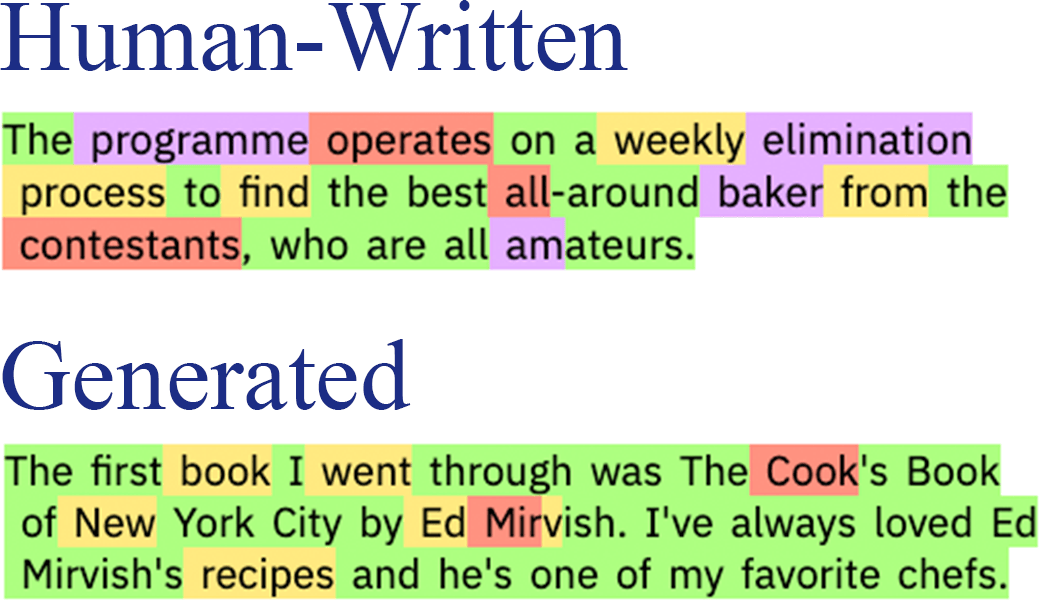
GLTR makes the difference between human and generated text visible by coloring tokens according to their rank under a language model. Its generated examples lean heavily toward the model's most likely choices; the human examples mix in more unexpected ones. Looking at those colors alongside the sampling strips above, there is a suggestive resemblance to the contrast between white and blue noise: stretches of predictable choices versus a more interspersed mix.
The hypothesis is that some of the difference between human and the measured generated text may be related to the temporal structure of sampling. A model reads its own choices as context, so the order in which predictable and surprising tokens arrive can influence the probabilities that follow. Blue noise could change that feedback by spreading exploration through the sequence. Comparing the token probabilities, ranks and run lengths of human text with white- and blue-noise generations would give that visual connection something measurable to follow.
09References
- Jan Boon (Kaetemi), "Stochastic Kernel-Switching Error Diffusion," blog.kaetemi.be, 2026.
- Jan Boon (Kaetemi), "Blue noise RNG for token sampling," llama.cpp pull request #19409, 2026.
- Ava (Solenopsisbot), "friend.cpp: Blue-noise sampling," an inference engine downstream of koboldcpp with the sampler integrated, 2026.
- R. W. Floyd, L. Steinberg, "An Adaptive Algorithm for Spatial Greyscale," Proceedings of the Society for Information Display, 1976.
- J. F. Jarvis, C. N. Judice, W. H. Ninke, "A Survey of Techniques for the Display of Continuous Tone Pictures on Bilevel Displays," Computer Graphics and Image Processing, 1976.
- R. A. Ulichney, "Dithering with Blue Noise," Proceedings of the IEEE, 1988.
- A. Holtzman, J. Buys, L. Du, M. Forbes, Y. Choi, "The Curious Case of Neural Text Degeneration," ICLR 2020. Degeneration, and the repetition loops of sampled decoding.
- S. Gehrmann, H. Strobelt, A. M. Rush, "GLTR: Statistical Detection and Visualization of Generated Text," ACL 2019, system demonstrations. Words colored by their rank under a model; generated text over-samples the head.